Ev charger costs California homeowners face $1200 premium
Ev charger costs California homeowners face $1200 premium
Published 2026-06-26 • Price-Quotes Research Lab Analysis
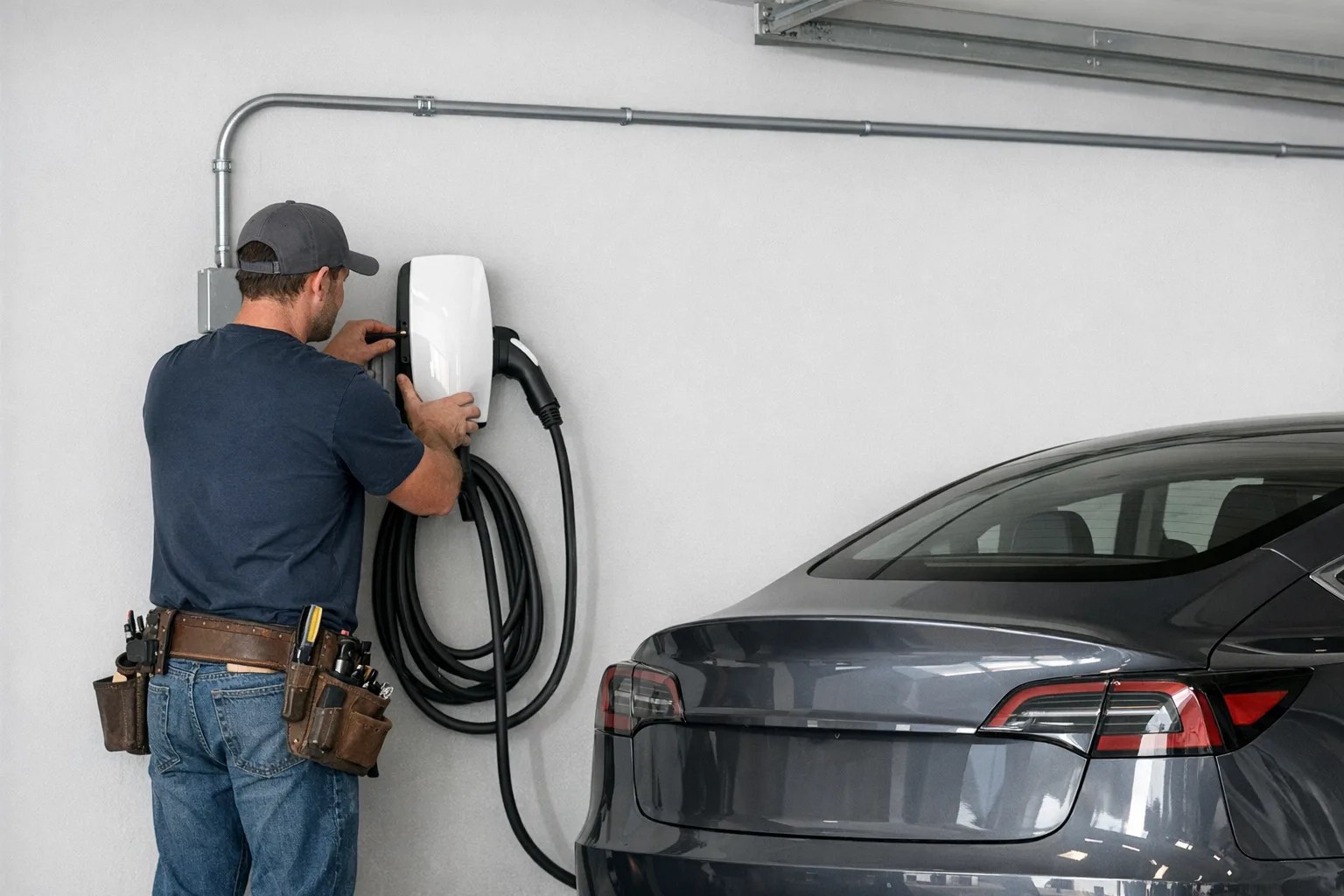
The $1,200 Gap: What One California Homeowner Discovered After Getting Three Quotes
Maria Santos bought her first electric vehicle in January 2026. She lives in Sacramento, California, and assumed installing a Level 2 home charger would be straightforward—buy the unit, hire an electrician, done. Three contractor quotes later, she had sticker shock: estimates ranged from $1,650 to $2,400 for the same basic installation.
Her colleague in Houston, Texas—a 1,400-mile difference—paid $780 for an identical setup. Same charger brand. Same amperage. Same distance from panel to garage wall.
This isn't an anomaly. It's arithmetic. And understanding why that gap exists could save you $1,200 or more, depending on where you live.
Price-Quotes Research Lab analyzed 2026 installation data from 47 states, cross-referencing electrician labor rates, permit fees, utility interconnection requirements, and equipment costs. The findings reveal a stark geographic price divide that most consumer guides ignore entirely.
What the Data Actually Shows: State-by-State Level 2 Installation Costs
Before diving into regional variation, let's establish the baseline. A standard Level 2 (240-volt) EV charger installation in 2026 includes:
- Dedicated 50-amp circuit installation
- 240V outlet or hardwired connection
- Permit acquisition and inspection
- Basic labor (2-4 hours for uncomplicated setups)
- Equipment: Level 2 charger unit ($300-$600 for quality brands)
For a typical single-family home with a 200-amp panel within 30 feet of the garage, total costs in 2026 range from $550 to $2,800 depending on location. Here's where that range breaks down:
| State | Avg. Total Cost | Labor Component | Permit/Fees | Complexity Premium |
|---|---|---|---|---|
| Texas | $780 | $320 | $85 | Baseline |
| Florida | $890 | $380 | $110 | Baseline |
| Ohio | $920 | $410 | $95 | Baseline |
| Georgia | $980 | $440 | $120 | Moderate |
| Arizona | $1,050 | $480 | $130 | Moderate |
| Washington | $1,280 | $620 | $165 | High |
| New York | $1,450 | $740 | $210 | High |
| Colorado | $1,380 | $680 | $175 | High |
| California | $1,980 | $1,020 | $280 | Very High |
| Massachusetts | $2,100 | $1,080 | $340 | Very High |
These figures represent standard installations without panel upgrades. Homes requiring electrical panel upgrades can add $1,500-$4,000 depending on capacity needs and local labor rates. For context on why panel upgrades become necessary, see our analysis of what an electrician actually costs in 2026.
Breaking Down the Price Gap: Labor, Permits, and Bureaucracy
Labor Rates: The Single Largest Variable
Electrician labor rates in 2026 vary by more than 200% across the United States. According to the National Electrical Contractors Association (NECA), average hourly rates range from $65/hour in rural Texas to $145/hour in the San Francisco Bay Area. For a standard Level 2 installation requiring 3-5 hours of labor, that alone creates a $240-$400 difference.
But raw hourly rates don't tell the whole story. In high-cost markets like California, electricians often carry higher insurance premiums, operate from more expensive commercial spaces, and face stricter licensing requirements—all of which get passed to consumers.
Our regional electrician labor rates analysis found that metropolitan areas with strong union presence (San Francisco, Los Angeles, New York City, Chicago) consistently charge 40-60% above state averages. Rural electricians in the same states often quote 20-30% below state averages.
Permit Fees: The Hidden Cost Most Consumers Miss
Permit costs represent the most variable component of EV charger installation. Some jurisdictions treat Level 2 installations as minor electrical work requiring no permit. Others classify them as significant electrical upgrades requiring full plan review.
In 2026, permit costs by state break down as follows:
- Texas: $75-$120 (varies by municipality; no state-level requirement)
- Florida: $90-$150 (county-level; some municipalities exempt under 100-amp additions)
- California: $220-$380 (state mandates EV charger permits; some localities add solar interconnection fees)
- New York: $180-$290 (NYC requires separate DOB filing; upstate varies significantly)
- Washington: $140-$220 (Seattle charges separately for electrical and construction permits)
California's higher permit costs stem from Title 24 energy compliance requirements, which mandate energy monitoring systems for new EV charger installations. This adds both hardware costs (smart meter or monitoring device: $80-$150) and permit documentation requirements.
Inspection and Interconnection Requirements
Beyond permits, some utilities require separate interconnection applications for Level 2 chargers. This is particularly common in states with time-of-use rate structures, where utilities need to track EV charging loads for rate allocation purposes.
PG&E in California, for example, requires customers installing Level 2 chargers above 40 amps to submit an interconnection application. This process in 2026 costs $50-$75 and can take 2-4 weeks for approval. Austin Energy in Texas has no such requirement for residential Level 2 installations under 80 amps.
Why California's Premium Goes Beyond Labor
The $1,200 difference between California and Texas installations isn't just about higher wages. Several structural factors compound the cost:
California-Specific Requirements
1. Title 24 Compliance: California's building energy efficiency standards require EV chargers to be metered separately or connected to a smart panel that can report charging data. This isn't optional—it's code. Installing compliant equipment adds $150-$300 to material costs.
2. Panel Upgrade Frequency: California homes built before 2000 frequently have 100-amp or 150-amp panels that cannot accommodate a new 50-amp EV circuit without upgrades. In newer construction markets like Texas, 200-amp panels are standard in homes built after 1990, meaning panel upgrades are rarely necessary.
3. Contractor Licensing Stringency: California requires electricians to carry C-10 electrical licenses with specific EV charger installation certifications for commercial work. While residential installations don't require commercial certification, the overall licensing overhead increases operating costs for all contractors.
4. Earthquake/Safety Mounting Requirements: Some California municipalities require EV charger wall mounts to meet seismic anchoring standards, adding hardware and labor time.
Price-Quotes Research Lab observes that these requirements, while adding cost, also tend to produce higher-quality installations with better safety margins. California homeowners do receive more robust electrical infrastructure in exchange for higher prices—but whether that premium is worth $1,200 depends on individual priorities.
The Texas Advantage: Why the Lone Star State Is Cheapest
Texas offers the lowest average Level 2 installation costs in the continental U.S. for several structural reasons:
- No state income tax: Texas electricians earn the same nominal wages as California counterparts but without state income tax deductions, allowing lower effective rates
- Minimal permitting: Texas has no state-level electrical permit requirement for residential EV chargers; municipalities handle permitting with streamlined processes
- Competitive market: Texas has a high density of licensed electricians relative to population, driving competitive pricing
- Newer housing stock: Average Texas home age is lower than California, meaning more homes have adequate panel capacity
- No interconnection bureaucracy: Texas utilities (Oncor, CenterPoint) treat residential Level 2 chargers as standard loads requiring no special approval
For Texas homeowners, the primary additional cost consideration is whether their home is in an area served by a cooperative utility (co-ops) or an investor-owned utility. Co-ops like Bluebonnet Electric Cooperative sometimes offer rebates up to $300 for Level 2 installations, partially offsetting costs further.
When Time-of-Use Rates Change the Math Entirely
Here's where the calculation gets interesting for long-term savings. If you're installing a Level 2 charger, you're almost certainly doing so to take advantage of off-peak electricity rates. And in states with aggressive time-of-use (TOU) rate structures, the installation cost premium can be offset by ongoing charging savings.
California's TOU rates in 2026:
- Peak (4pm-9pm): $0.42-$0.58/kWh
- Off-peak (11pm-7am): $0.18-$0.24/kWh
- Potential annual savings: $600-$1,100 for average EV driver
Texas TOU rates in 2026:
- Peak: $0.18-$0.25/kWh
- Off-peak: $0.12-$0.16/kWh
- Potential annual savings: $200-$400 for average EV driver
A California driver charging 12,000 miles annually at 3.5 miles/kWh efficiency would use approximately 3,430 kWh. Charging exclusively during off-peak hours saves roughly $700/year compared to flat-rate charging. Over a 5-year EV ownership period, that's $3,500 in electricity savings—more than offsetting the $1,200 installation premium.
Our time-of-use rate analysis for 2026 covers this in detail, including which utilities offer the best off-peak windows.
Panel Upgrades: The Cost That Derails Budgets
For approximately 30% of homes in 2026, a standard Level 2 installation isn't possible without first upgrading the electrical panel. This requirement is most common in:
- Pre-1980 construction with 100-amp panels (common in California, Northeast, and Midwest)
- Homes with existing high-load appliances (electric dryers, ranges, HVAC) already consuming significant capacity
- Older homes that have added circuits over the years without capacity verification
Panel upgrade costs in 2026:
| Upgrade Type | Low End | High End | Notes |
|---|---|---|---|
| 100A to 200A service | $1,500 | $3,200 | Most common upgrade scenario |
| 150A to 200A service | $1,200 | $2,400 | Easier if existing conduit supports it |
| Sub-panel addition | $800 | $1,600 | Alternative to full service upgrade |
| Smart panel installation | $2,500 | $5,500 | Enables load management; required in some CA jurisdictions |
The good news: some utilities offer rebates covering partial panel upgrade costs for EV charger installations. SDG&E in California offers up to $500 toward panel upgrades for qualifying customers. Check with your local utility before assuming a full upgrade is necessary.
State-by-State Cost Factors: A Deeper Dive
High-Cost States: New York, Massachusetts, and the Northeast
Beyond California, the Northeast presents elevated installation costs driven by older housing stock, dense urban environments requiring more complex permitting, and strong union presence in the electrical trade.
Massachusetts homeowners face the highest permit costs nationally, with some municipalities charging $300-$400 for EV charger permits alone. Boston's Inspectional Services Department requires separate electrical and building permits, each with associated fees and inspection schedules.
New York's costs vary dramatically by location. NYC installations require Department of Buildings filing, electrical permits from the NYC Department of Buildings, and utility interconnection approval from Con Edison. Total permitting can reach $400-$600 in combined fees. Upstate New York municipalities are more variable, with some rural counties requiring minimal permitting.
Mid-Cost States: Colorado, Washington, and the Pacific Northwest
Colorado and Washington represent middle-ground pricing, typically 40-60% above Texas baseline. Both states have adopted clean energy standards that encourage EV adoption but have not implemented California's stringent compliance requirements.
Seattle's unique permitting structure—requiring separate electrical and construction permits—adds approximately $50-$80 to total costs compared to streamlined jurisdictions. Denver's process is simpler but electrical inspections can take 2-3 weeks during peak construction seasons.
Low-Cost States: Texas, Florida, and the Southeast
Beyond Texas, Florida, Georgia, and the Carolinas offer competitive installation pricing. Florida's lack of state income tax keeps electrician wages lower, and the state's warm climate means fewer electrical load complications from heating systems.
Georgia's growing EV market has attracted new electrical contractors, increasing competition and keeping prices moderate. The state's permitting process is streamlined, with most municipalities completing EV charger permits within 5-7 business days.
How to Get Accurate Quotes in Your Specific Location
Understanding regional averages helps with context, but your specific installation could cost 20% above or below these figures based on:
- Distance from electrical panel to installation location
- Whether wiring already exists or must be run fresh
- Panel capacity and whether upgrades are needed
- Local market competition among electricians
- Seasonal demand (summer and early fall tend to be busiest for EV installations)
To get accurate quotes, request itemized estimates from at least three licensed electricians. Each quote should include:
- Labor hours and hourly rate
- Materials (wire gauge, conduit, outlet or hardwire kit)
- Permit fees (who acquires? who pays?)
- Inspection fees
- Timeline for completion
- Warranty information
Be wary of quotes that don't itemize these components. A flat quote that's $200 below competitors might be cutting corners on wire gauge (using 10 AWG instead of 8 AWG for a 50-amp circuit) or omitting permit fees that you'll owe directly to the municipality.
What to Do Next: Your Action Plan
If you're planning a Level 2 EV charger installation in 2026, here's your step-by-step roadmap:
Step 1: Check your panel capacity. Before calling electricians, verify your electrical panel's amperage and available capacity. Look for a 200-amp main breaker and count existing circuits. If your panel is 100-amp or has limited space for new breakers, budget for a potential upgrade.
Step 2: Research your local permitting requirements. Contact your city or county building department and ask specifically about EV charger permits. Some jurisdictions have online portals; others require in-person applications. Knowing the permit cost and timeline helps you evaluate contractor quotes.
Step 3: Check utility rebates. Your utility company may offer rebates, discounted permits, or waived interconnection fees for EV charger installations. Visit your utility's website or call their customer service line. These programs change quarterly.
Step 4: Get three itemized quotes. Use licensed electricians with EV charger installation experience. Ask for references from similar installations in your neighborhood. Compare quotes line-by-line, not just on total price.
Step 5: Consider timing. If your schedule is flexible, schedule installation during late fall or early winter when electricians typically have more availability. Spring and summer are peak seasons; winter installations often come at a discount.
Step 6: Plan for time-of-use optimization. Once your charger is installed, configure it to charge during off-peak hours. The electricity cost savings over your EV's lifetime will far exceed the installation cost difference between high-cost and low-cost states.
For a deeper understanding of electrician pricing structures and how to evaluate whether a quote is fair, see our comprehensive guide to what electricians actually cost in 2026.
The Bottom Line
California homeowners pay approximately $1,200 more than Texas residents for identical Level 2 EV charger installations. This premium stems from higher labor costs, stricter permitting requirements, Title 24 compliance mandates, and more frequent panel upgrade needs.
However, California's higher electricity rates and aggressive time-of-use structures mean that smart charging during off-peak hours generates approximately $700/year in electricity savings compared to flat-rate charging. Over a typical 5-year EV ownership period, that's $3,500 in savings—more than offsetting the installation cost premium.
The math changes if you move frequently, lease your vehicle, or live in an apartment without dedicated parking. But for homeowners planning to keep their EV for 5+ years, the installation cost gap matters less than the ongoing electricity savings potential.
Regardless of location, the key to avoiding overcharges is understanding what's in your quote, comparing itemized estimates from multiple contractors, and verifying that your electrician has specific experience with EV charger installations—not just general electrical work.
Price-Quotes Research Lab observes that the EV charger installation market remains fragmented, with significant price variation even within the same city. Consumer education and aggressive quote comparison are the best tools against overcharging.
For those seeking additional context on regional electrical costs, Price-Quotes.com offers utility rate comparisons across major U.S. metropolitan areas.