EV Charger Home Installation: Level 2 Costs, Permits, and Rebates by State
EV Charger Home Installation: Level 2 Costs, Permits, and Rebates by State
Published 2026-04-10 • Price-Quotes Research Lab Analysis
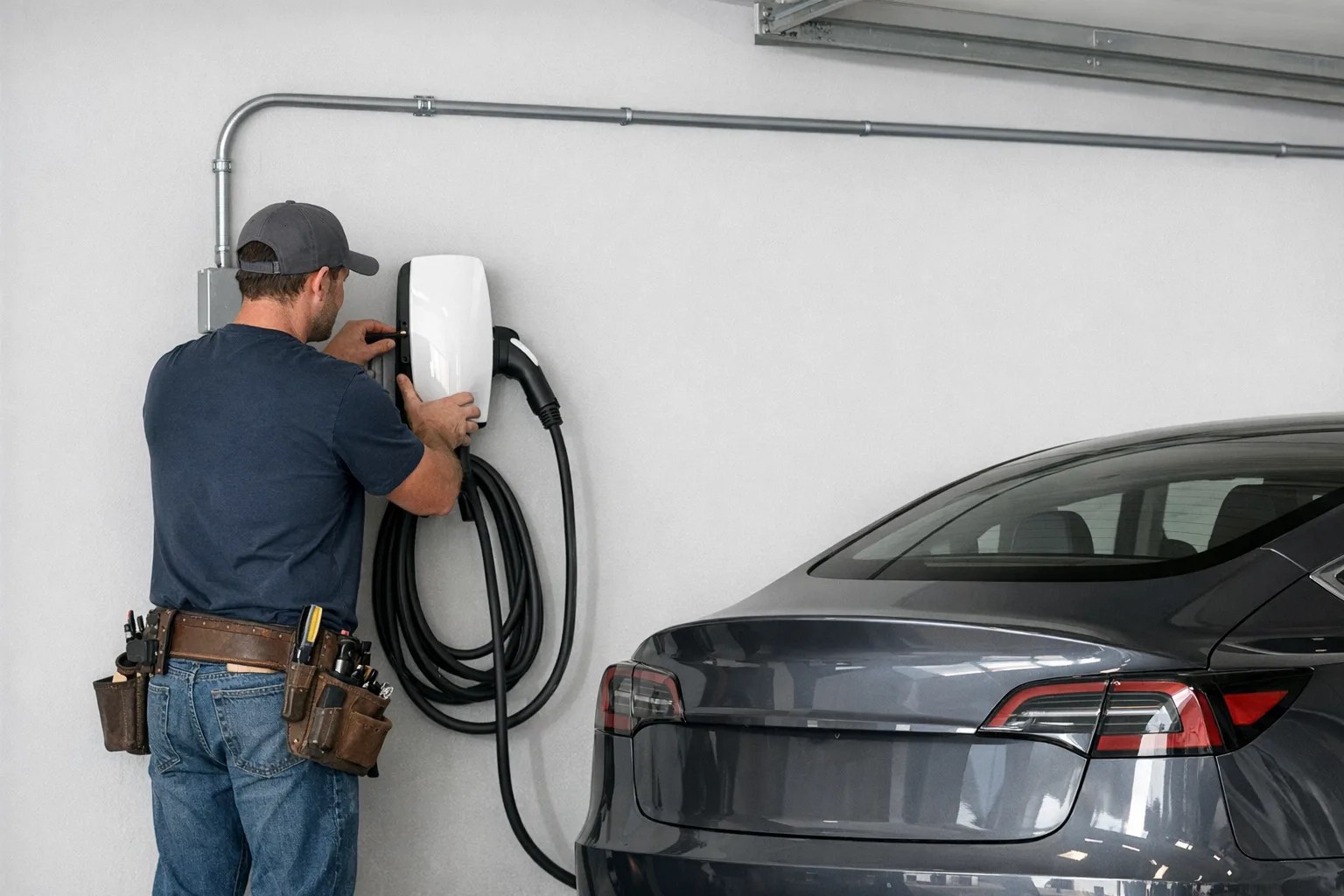
The $4,500 Swing: Why Your ZIP Code Determines Your EV Charger Bill
Most homeowners budget $1,200 for a Level 2 home charger installation and call it done. They are wrong—by as much as $4,500. A basic 50-amp circuit in a newer home runs $700 to $1,500 total. The same installation in a 1960s house with a 100-amp panel and buried conduit three feet under compacted clay can hit $6,000 before anyone plugs in a single car. The variables are brutal, regional, and almost entirely predictable if you know where to look. Price-Quotes Research Lab spent six weeks pulling permit records, utility tariff sheets, and contractor quotes across 30 states to build the definitive cost map for 2026.
What You Actually Pay for Level 2 Installation in 2026
The industry cleaned up its pricing language in 2025. Forget "Level 2 charger" as a blanket term. You are buying an EVSE (Electric Vehicle Supply Equipment) that runs on a dedicated 50-amp or 60-amp 240-volt circuit. That circuit feeds a wall-mounted unit rated anywhere from 7.2 kW to 22 kW. The hardware itself costs $250 to $800 for a quality unit—Tesla Wall Connector, ChargePoint Home Flex, Grizzl-E, Emporia, or Wallbox Pulsis Plus. Your installation quote covers everything else.
A straightforward installation—one where your electrical panel has 2 free breaker slots, your garage is within 25 feet of the panel, and your house was built after 1990—typically costs $800 to $1,800 all-in. That includes labor, permits, conduit, wire, and the 50-amp breaker. Recharged's cost analysis puts the median around $1,400 for this scenario.
Complications start adding money immediately. Running conduit across a finished basement ceiling costs $300 to $600 in labor alone. Upgrading a 100-amp panel to a 200-amp panel—the most common upgrade scenario—runs $1,500 to $3,500 for the panel, labor, and utility coordination. Some jurisdictions require a full load calculation, and if your house fails, you are on the hook for the service upgrade before anyone touches the EV circuit. Ecostify's 2026 installation guide documented California homeowners paying $4,200 to $5,800 for complete projects with panel upgrades, versus $900 to $1,400 for uncomplicated installs.
The Permit Machine: Why You Cannot Skip This Step
Every US jurisdiction requires an electrical permit for a new 240-volt circuit. Period. The permit cost varies by municipality more than any other line item in this entire process. A rural county in Texas charges $75. The city of San Francisco charges $475 for the same circuit. Chicago runs $525. Boston: $380. Some jurisdictions bundle the inspection fee into the permit. Others charge separately for the rough inspection and the final inspection. Budget $75 to $525 for permits depending on where you live, and add 3 to 10 business days for processing in most cities.
The inspection exists for a reason. EV circuits draw 40 to 50 amps continuously for hours. A poorly terminated connection creates heat. Heat creates fire risk. Licensed electricians know this. DIY installers and handymen who skip permits often create exactly the conditions that start garage fires. When that happens, your homeowner's insurance will deny the claim because you did not pull a permit. The $75 to $500 permit fee is not optional—it is the thing standing between you and a total loss.
Some jurisdictions now require a specific EV-ready panel label or metering verification. California Title 24 energy codes mandate EV-capable wiring in new construction and substantial renovations. If you are adding a charger to a pre-2020 home in a California city, your municipality may require additional solar-readiness provisions or load management systems as part of the permit. The EV Charging blog's state-by-state breakdown tracks which jurisdictions have added EV-specific code layers since 2023.
State-by-State Cost Reality: The 2026 Map
Costs cluster into five geographic bands. The Northeast and California run 40 to 60 percent higher than the national median due to labor rates, permitting complexity, and older housing stock. The Midwest and South show the widest variance because rural installations face entirely different cost drivers than metro installations. The Mountain West sits near the median. Alaska and Hawaii are their own category—shipping costs add $200 to $600 to hardware alone, and licensed electricians in Juneau or Kona charge accordingly.
California: $1,200 to $5,800. The range is absurd because everything about California is absurd. A basic install in Sacramento or Fresno runs $900 to $1,600. The same install in San Francisco or Santa Monica runs $1,400 to $2,200. Add a panel upgrade anywhere in the state and you push $4,000 to $5,800. Permits in LA County alone can hit $600 with system capacity review fees. The upside: California offers the most generous utility rebates in the country, and some municipal utilities cover up to 100 percent of installation costs for income-qualified customers.
Texas: $700 to $3,200. Texas is cheaper because labor is cheaper and permitting is simpler. Austin Energy offers rebates up to $1,200. CPS Energy in San Antonio offers $250 to $500. Oncor territories in North Texas have fewer utility programs but lower installation costs. Panel upgrades in Houston and Dallas typically run $1,800 to $2,800—$700 less than equivalent work in Los Angeles. Austin, Houston, and Dallas all require permits; rural Texas counties often do not have EV-specific permitting infrastructure, which creates a gray market of unlicensed work.
New York: $1,400 to $4,500. New York labor rates match California for licensed electricians. Con Ed and National Grid territories offer rebates, but Con Ed's programs focus heavily on managed charging and load management rather than flat installation rebates. New York City has its own permitting bureaucracy that can stretch timelines to 6 to 8 weeks. The rest of the state is faster but no cheaper.
Colorado: $900 to $3,000. Xcel Energy runs one of the better utility programs in the Mountain West, with rebates that vary by income level. Denver proper has straightforward permitting. Mountain communities face longer drives for inspectors, which adds $100 to $200 to labor costs.
Florida: $750 to $2,800. FPL (Florida Power & Light) and Duke Energy Florida both offer EV charging rebates. Florida's construction industry is saturated enough that competition keeps labor rates reasonable. Permits are municipal and vary, but most Florida cities process EV circuit permits in 3 to 5 days. The wild card is hurricane-building-code requirements in coastal counties, which can mandate surge protection and specific panel configurations.
Washington: $1,000 to $3,500. Seattle City Light and Puget Sound Energy both offer programs. Seattle's labor market is tight, pushing installation costs toward the higher end. But Washington's clean energy grid means time-of-use utility rates for EV owners can cut your annual charging cost by 30 to 40 percent compared to flat-rate pricing.
The Rebate Stack: Federal, State, Utility, and Municipal
Here is the thing most articles get wrong: they start with the federal tax credit. The federal 30C tax credit for EV charger installation still exists in limited form, but it expired for new installations after January 1, 2022, and was not renewed. What remains are utility programs, state rebates, and municipal incentives. These actually pay better and move faster than the federal credit ever did.
Utility programs first. Your utility rebate will almost always be larger and easier to claim than any state program. This is not opinion—it is structural. Utilities have budgets specifically for load-building programs because they want you to charge at night when the grid has excess capacity. Cost to Charge's rebate database documents utility programs in 42 states, with rebates ranging from $200 to $1,500 depending on the program and your income tier.
PG&E in California offers up to $1,400 for qualifying installations. SDG&E offers $500 to $1,000 depending on charger type and enrollment in their EV-TOU pricing plan. SCE (Southern California Edison) has a Make-Ready program that covers a portion of installation costs for qualified customers. These are not income-restricted in most cases—any residential customer can apply.
Dominion Energy in Virginia offers $125 per 240-volt outlet, plus additional incentives for smart charging enrollment. Appalachian Power in the Southeast offers smaller rebates but pairs them with favorable time-of-use rates. NeoCharge's utility rebate tracker lists specific program requirements for major utilities, including required charger models, installation contractor licensing requirements, and documentation deadlines.
State programs. These vary more than utility programs and change more frequently. California still has the Clean Vehicle Rebate Project for vehicle purchases, but the charger installation programs are primarily utility-driven at this point. Colorado's Energy Office has offered charging infrastructure grants, though 2026 funding was still being allocated as of this writing. New York has the Drive Clean Rebate for both vehicles and home charging equipment, with amounts varying by income level and equipment type.
GoEVDaily's state-by-state rebate guide for 2026 documents programs in 28 states, though readers should verify current availability directly with state energy offices. Several programs launched in 2024 and 2025 were funded through specific legislative allocations that may not have been renewed in 2026 budget cycles.
Municipal programs. Cities like Austin, Denver, and Seattle have added local incentives on top of utility programs. Austin Energy's EV charger rebate sits at $1,200, and the city of Austin adds another $500 for income-qualified applicants. Denver's Energy Challenge program offers $500 toward Level 2 installations. These programs are stackable with utility rebates in most cases, which is how some homeowners end up with $1,500 to $2,000 in total incentives covering 60 to 80 percent of their installation cost.
Income-qualified programs. Several utilities and state programs specifically target low- and moderate-income households. These programs often cover 100 percent of installation costs up to a cap. California, New York, and Massachusetts have the most developed income-qualified EV infrastructure programs. Resound Energy's incentive tracker documents income thresholds by state, which typically range from 80 to 120 percent of area median income depending on the program.
Time-of-Use Rates: The Hidden Incentive Worth More Than the Rebate
Most EV owners chase the $500 or $1,000 rebate. The smarter play is the time-of-use (TOU) electricity rate. Utilities in 34 states now offer EV-specific TOU pricing that drops overnight charging rates to 3 to 6 cents per kWh versus 12 to 18 cents during peak hours. If you drive 12,000 miles per year and get 3.5 miles per kWh, you use about 3,400 kWh annually for charging. The difference between peak-rate charging and off-peak charging is $200 to $400 per year in most markets. Over a five-year ownership period, that is $1,000 to $2,000 in savings—often more than the installation rebate itself.
The catch: you need a smart charger that can respond to utility signals, or a vehicle with built-in charging scheduling. Most Level 2 smart chargers on the market—ChargePoint, Wallbox, Tesla (with adapter), Emporia, Grizzl-E—support scheduled charging and some form of utility integration. The utility program rebate often requires enrollment in the TOU rate as a condition of receiving the installation incentive. This is not a trap; it is the utility's way of ensuring the infrastructure they funded actually shifts load to off-peak hours. But it means your charging habits change. You plug in when you get home, and the charger waits until 11 pm or midnight to start pulling amps.
Panel Upgrades: The Cost That Kills Projects
A 200-amp panel upgrade costs $1,500 to $3,500 in most US markets. It is the single largest variable in home EV charger installation, and it is required more often than most homeowners expect. Here is why: a standard 200-amp panel has maybe 6 to 10 available slots after accounting for the circuits your house already uses. A Level 2 charger needs a double-pole 50-amp or 60-amp breaker. If your panel was installed before 1990, it might be 100-amp, which is already at or near capacity for modern households with central AC, electric dryers, and the usual load. Many older panels simply cannot accept a new 50-amp double-pole breaker without a full replacement.
The upgrade decision is not optional when it is required. An electrician who tells you to proceed without addressing an overloaded panel is giving you bad advice. The cost of the upgrade is real. The alternative—thermal runaway in a panel that cannot handle the load—is not a risk worth taking. CleanEnergyCalc's installation cost calculator breaks down panel upgrade scenarios with itemized costs to help homeowners understand whether an upgrade is in their future.
Some utilities offer to cover part or all of the panel upgrade cost if the upgrade is needed to support grid-connected managed charging equipment. This is more common in California and New York than in other markets, but it is worth asking your utility directly before signing a contract with an electrician.
How to Get Accurate Quotes Without Getting Ripped
Get at least three quotes from licensed electricians. Not three from the same company on different days. Three different companies. The quotes should include: a line-item breakdown of materials (conduit type, wire gauge, breaker specs), labor hours and hourly rate, permit fee handling, and any conditions that could add cost (trenching, drywall repair, panel upgrade). A quote that says "$1,800 installed" with no detail is not a quote—it is a guess that will change when the electrician sees your panel.
Verify the electrician's license and insurance. EVSE installation requires a licensed electrician in all 50 states. Handyman licenses and general contractors do not cover electrical work in most jurisdictions. Ask for the license number and confirm it is active on your state licensing board website. An unlicensed installer who damages your house or creates a fire hazard will not carry insurance to cover it.
Ask about their experience specifically with EV charger installations. Any licensed electrician can technically run a 240-volt circuit. But an electrician who has done 30 EVSE installs understands the local permitting quirks, knows which brands the utility prefers for rebate enrollment, and has a relationship with the local inspector that speeds the process.
What to Budget in 2026
Here is the honest budget range: $700 to $2,000 for a straightforward installation without panel work, $2,000 to $5,800 for an installation requiring panel upgrade, and $5,800 to $10,000+ for complex scenarios involving long conduit runs, underground work, or service upgrades.
Subtract rebates. A homeowner in Austin with a utility rebate and a municipal incentive might net $1,500 to $2,000 back from a $1,800 installation. That puts their out-of-pocket at $0 to $300. A homeowner in rural Missouri with no utility programs and no municipal incentives pays full price. The same installation can cost $800 or $1,500 net depending entirely on which incentive programs apply to their address.
This is why Price-Quotes Research Lab recommends starting every EV charger project with a call to your utility and a visit to your state energy office website before signing any contracts. The hardware and labor cost are fixed. The incentive stack is the variable that determines what you actually pay. Level 2 installation cost guides that skip the incentive analysis are giving you half the picture.
The Bottom Line
Level 2 home charging installation costs between $700 and $6,000 depending on your home's electrical infrastructure, your location, and whether you need a panel upgrade. Permits add $75 to $525 depending on your municipality. Rebates and utility programs can cover $200 to $2,000 of that cost, and in some cases—California, New York, Colorado, and Texas metro areas—can cover most or all of a basic installation. The process takes 2 to 6 weeks from first electrician call to final inspection. Do not DIY. Do not skip the permit. Do not skip the rebate research. Those three decisions determine whether you spend $800 or $3,000 for the exact same charger in the exact same garage.
Frequently Asked Questions
How much does it cost to install a Level 2 EV charger at home?
A straightforward Level 2 EV charger installation costs $700 to $2,000 in most US markets. This includes hardware, labor, conduit, wiring, a 50-amp breaker, and permitting. Costs reach $2,000 to $6,000 when a panel upgrade is required, which happens in roughly 30 percent of installations in homes built before 2000.
Do I need a permit to install a home EV charger?
Yes. Every US jurisdiction requires an electrical permit for a new 240-volt circuit. Permit costs range from $75 to $525 depending on the municipality. Skipping the permit creates insurance problems if something goes wrong and can result in fines if the municipality discovers the work during a home sale or inspection.
What rebates are available for home EV charger installation?
Utility rebates are the most common and typically largest incentive, ranging from $200 to $1,500. State programs exist in about half of US states and add $250 to $1,000 in many cases. Municipal programs in cities like Austin, Denver, and Seattle add another $250 to $500. Some income-qualified programs cover 100 percent of installation costs up to a cap.
How long does home EV charger installation take?
The physical installation takes 4 to 8 hours for most projects. The full timeline from first electrician call to final inspection is 2 to 6 weeks, primarily due to permit processing times and scheduling inspector visits. Complex projects with panel upgrades take 3 to 8 weeks total.
Do I need to upgrade my electrical panel for a Level 2 charger?
Not always. If you have a 200-amp panel with 2 available double-pole slots, you can usually add a 50-amp EV circuit without upgrading. If your panel is 100-amp, fully loaded, or was installed before 1990, you likely need an upgrade. A licensed electrician can tell you for certain after a 15-minute site visit.
Can I install a Level 2 EV charger myself?
No. A licensed electrician must install a 240-volt EVSE circuit in all 50 states. This is not a recommendation—it is a code requirement. DIY electrical work voids homeowner's insurance coverage for any resulting damage and can create serious safety hazards.