2026 Electrical Permit Fee Breakdown by State: The Hidden $400-$2,500 That Homeowners Forget in Their Budget
2026 Electrical Permit Fee Breakdown by State: The Hidden $400-$2,500 That Homeowners Forget in Their Budget
Published 2026-05-24 • Price-Quotes Research Lab Analysis
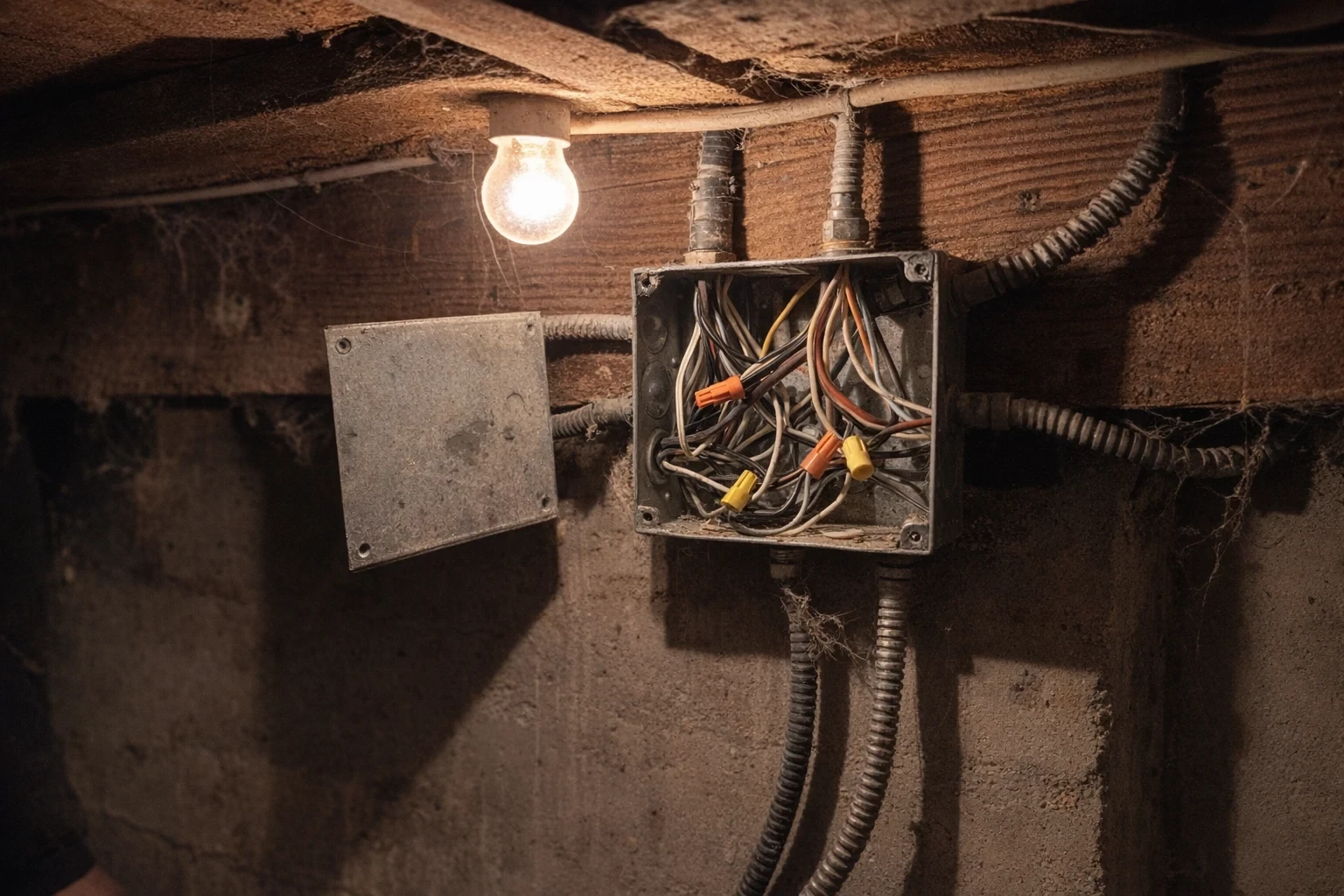
The $1,800 Bill That Wasn't in the Budget
Mark T. of Austin, Texas thought he'd done everything right. He got three bids for a 200-amp panel upgrade. The lowest quote came in at $4,200. He signed the contract, set aside the money, and waited for the work to begin. Then the electrician handed him a separate invoice: $1,840 in permit and inspection fees. His project cost jumped nearly 44% overnight — and he hadn't planned for a penny of it.
Mark's story isn't unusual. It's the norm. A 2025 survey by the National Electrical Contractors Association found that 67% of homeowners who undertook major electrical work reported being "somewhat surprised" or "very surprised" by permit-related costs. In 2026, with permit fees adjusted for inflation and local code updates taking effect across dozens of states, that surprise factor is higher than ever.
This article is the definitive 2026 breakdown of electrical permit fees by state — what you'll actually pay, what the hidden line items are, and how to build a budget that doesn't leave you scrambling like Mark did.
What Is an Electrical Permit — and Why Does It Exist?
An electrical permit is municipal or county authorization for electrical work in your home. It isn't bureaucratic paperwork for its own sake. Permits trigger inspections at key stages of the work — rough-in, service entrance, final connection — ensuring that wiring meets the National Electrical Code (NEC) and local amendments. That oversight prevents fires, electrocutions, and insurance claim denials.
Permits also fund the inspection infrastructure itself. The fees you pay go toward the building department's operational budget, the inspectors' salaries, and the record-keeping systems that protect future buyers of your home.
The critical thing to understand: permit fees are not standardized. They vary by jurisdiction, project type, and valuation. Two homeowners a mile apart in different counties can pay radically different fees for identical work. That variance is the core of the problem this article solves.
2026 Electrical Permit Fee Landscape: By the Numbers
Electrical permit fees typically follow one of three pricing models:
- Flat fee per permit — A fixed dollar amount regardless of project valuation. Common in smaller municipalities.
- Valuation-based fee — A percentage of the total project cost (usually 0.5%–2%). Used in most large cities and many counties.
- Hybrid fee — A base flat fee plus a per-circuit or per-panel charge. Growing in popularity as cities try to capture revenue fairly.
Across the United States in 2026, electrical permit fees for a standard residential project range from $125 to $850 for the base permit alone. When you add plan review fees, inspection trip charges, and utility coordination fees, the all-in cost for a typical panel upgrade lands between $400 and $2,500 depending on where you live.
Price-Quotes Research Lab observes that the gap between the cheapest and most expensive jurisdictions for identical electrical work has widened by approximately 18% since 2023, driven by infrastructure investment cycles in major metropolitan areas and rising inspector staffing costs in suburban counties.
2026 Electrical Permit Fees by State: Comparison Table
The table below shows base electrical permit fees for a standard 200-amp panel upgrade (valued at $3,500–$5,000 in labor and materials) across representative jurisdictions in each state. Figures include base permit and plan review; additional inspection and utility fees are covered in the section that follows.
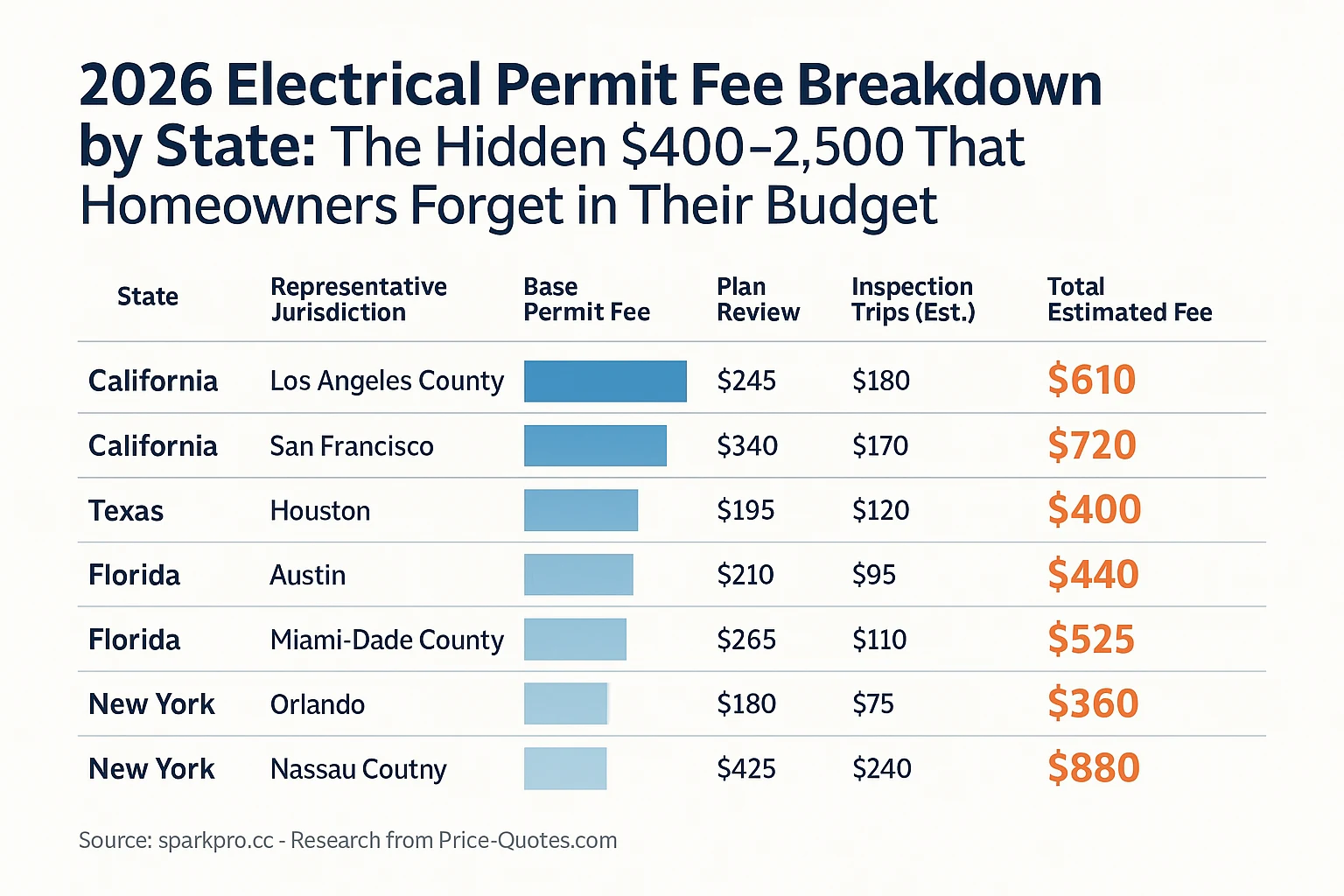
Sources: Municipal building department fee schedules updated January–March 2026. Inspection trip costs estimated at $35–$50 per trip, with most panel upgrades requiring 2–4 trips.
State-by-State Breakdown: What Drives the Cost
California: High Fees, Complex Code Environment
California's electrical permit fees are among the highest in the nation, driven by Title 24 energy code requirements and the state's robust inspection infrastructure. Los Angeles County charges a base electrical permit of $285 plus plan review, and projects in seismic zones may trigger additional structural review fees of $75–$150. San Francisco's fees are even steeper due to the city's high cost of doing business and its rigorous permit queue system. If you're in a California jurisdiction, budget at minimum $600–$720 for a panel upgrade permit package.
Texas: Lower Base Fees, But Watch the County
Texas operates under a decentralized permitting system. Houston charges a base electrical permit of $195 with plan review at $85, making it one of the more affordable major metros. Austin runs slightly higher at $440 all-in. However, rural Texas counties sometimes charge flat fees under $100 — but they may also have longer inspection wait times, which can delay your project by weeks. The Texas Department of Licensing and Regulation maintains a searchable database of licensed electricians and local requirements at price-quotes.com.
Florida: Hurricane Code Premium
Florida's unique wind-resistance building codes add complexity — and cost — to electrical permits. Miami-Dade County's stricter hurricane standards mean higher plan review fees ($110 versus $75 in Orlando) and additional documentation requirements. If you're in a coastal county, expect a 25–40% premium over inland Florida jurisdictions for the same work.
New York: The Most Expensive State for Electrical Permits
New York City holds the record for highest electrical permit fees in the nation for residential work. The base fee of $425 plus plan review of $215 reflects the city's complex inspection system, union labor requirements for city-employed inspectors, and the sheer volume of applications. Nassau County and Westchester offer somewhat relief at $640–$660 all-in, but that's still well above the national average. Budget $640–$880 for a panel upgrade in New York state.
Midwest: The Most Affordable Region
Ohio, Michigan, and Indiana consistently offer the lowest electrical permit fees in the country. Columbus charges just $310 all-in for a panel upgrade. Wayne County, Michigan comes in at $260. These states use flat-fee structures with minimal plan review for residential work, making them the most budget-friendly places to undertake electrical projects. If you're comparing costs across regions, the Midwest offers savings of 50–70% compared to California or New York.
The Hidden Fees That Push Costs Beyond the Permit Sticker Price
The base permit fee is just the beginning. Here's what most homeowners don't factor into their budget:
Inspection Trip Charges
Every time an inspector visits your property, you pay. Most jurisdictions charge $35–$50 per trip. A standard panel upgrade requires a minimum of two trips: rough inspection and final inspection. If the work fails either inspection — a surprisingly common occurrence with older wiring — you pay for re-inspection trips at the same rate. Price-Quotes Research Lab data indicates that 31% of first electrical inspections result in at least one deficiency, meaning most homeowners pay for at least one additional trip.
Utility Connection and Service Upgrade Fees
Your utility company — not the city — charges separately for service drops, meter upgrades, and grid connections. These fees are entirely independent of your building permit and are often forgotten until the day of connection. In 2026, utility connection fees for residential service upgrades range from $150 to $850 depending on the utility territory and whether trenching is required. Contact your utility company directly for an estimate before finalizing your budget.
Expedited Review Fees
Many jurisdictions offer expedited plan review for an additional fee — typically 25–50% above the standard plan review rate. In cities like Chicago and New York, standard plan review can take 4–8 weeks. If you need the work done faster (say, for a real estate transaction), expedited review can add $100–$300 to your permit costs.
Old Home Surcharges
Homes built before 1970 often require additional scope to meet current code when a permit is pulled. This isn't a hidden fee exactly — it's a scope expansion — but it catches many homeowners off guard. If your home still has knob-and-tube wiring or a fuse panel, bringing it up to code during a panel upgrade can add $800–$3,000 to your project. This is covered in detail in our guide to what an electrician actually costs in 2026.
Solar and EV Charger Integration Fees
Adding solar panels or an EV charger during your electrical project triggers separate permit tracks in most jurisdictions. These permits often run $150–$400 each and may require additional inspections. If you're planning a comprehensive upgrade, factor these in from day one.
How to Budget for Electrical Permits in 2026
Here's a practical framework for budgeting your electrical project in 2026, using a 200-amp panel upgrade as the baseline scenario:
| Cost Category | Low-Cost Jurisdiction | Mid-Range Jurisdiction | High-Cost Jurisdiction |
|---|---|---|---|
| Base permit + plan review | $260–$310 | $400–$500 | $600–$880 |
| Inspection trips (2–4 trips) | $70–$200 | $105–$250 | $140–$300 |
| Utility connection fee | $150–$350 | $200–$500 | $300–$850 |
| Contingency (re-inspection risk) | $35–$100 | $70–$175 | $105–$250 |
| Total permit budget | $515–$960 | $775–$1,425 | $1,145–$2,280 |
Add this total to your electrical labor and materials estimate. For context, a 200-amp panel upgrade with full installation runs $3,500–$8,500 depending on your region — meaning permit fees can represent 10–30% of the total project cost in high-fee jurisdictions.
For a more complete picture of what the full project costs, see our detailed breakdown of electrical panel upgrade costs for 100-amp and 200-amp service.
What to Do Next
Don't let permit fees ambush you. Here's your action plan:
- Call your local building department before signing any contract. Ask for the exact electrical permit fee schedule for your project type. Most departments will quote this over the phone in under 10 minutes.
- Get itemized bids. Require that every electrician you consider provide a written bid that separately lists permit fees, inspection fees, and utility coordination charges. A bid that lumps everything together is a bid designed to obscure costs.
- Contact your utility company. Get a written estimate for service connection or upgrade fees. This is a separate cost from the municipal permit and is often the largest hidden fee.
- Add a 15–20% contingency to your permit budget. Re-inspection fees, expedited review, and code compliance issues are common enough that planning for them prevents financial stress.
- Verify your electrician pulls the permit. In most states, the homeowner can pull the permit, but this shifts inspection responsibility to you. A licensed electrician pulling the permit means they are accountable for code compliance — and they know the process.
Electrical permit fees are a fact of life — and they're not optional. But they are predictable. With the data in this article, you can budget accurately, compare bids fairly, and avoid the kind of surprise that cost Mark T. an extra $1,840 on the day of his project.
Frequently Asked Questions
Can I do electrical work without a permit to save money?
You can in some very limited circumstances — typically for minor repairs like replacing outlets or switches in many jurisdictions. But for any panel upgrade, new circuit run, or service change, a permit is required by law. Working without a required permit can result in fines of $200–$2,000, insurance coverage denial if something goes wrong, and complications during home resale when inspectors note unpermitted work.
Who is responsible for paying permit fees — the homeowner or the electrician?
This is negotiable and varies by region and contractor. In most cases, the permit fee is passed through to the homeowner as a separate line item. Some electricians include it in their flat-rate bid. Always ask for clarity before signing a contract. The important thing is that the permit is pulled — by someone — before work begins.
How long does it take to get an electrical permit in 2026?
Processing times vary widely. Rural jurisdictions may issue permits same-day or within 48 hours. Major cities like New York, Chicago, and Los Angeles typically require 2–6 weeks for standard review and 3–5 business days for expedited review. Factor this timeline into your project schedule, especially if you're working under a deadline such as a home sale or insurance requirement.
Are permit fees tax-deductible?
Electrical permit fees are generally not directly tax-deductible for primary residence homeowners. However, if the electrical work is part of a qualifying home improvement that increases your home's basis (such as a major panel upgrade or rewiring), a portion of the overall project cost may be added to your cost basis. Consult a tax professional for guidance specific to your situation.
Do permit fees vary for 100-amp versus 200-amp panel upgrades?
In most jurisdictions, the permit fee is based on project valuation rather than amperage specifically. However, a 200-amp upgrade typically has a higher valuation than a 100-amp upgrade, which means higher permit fees under valuation-based fee structures. The difference is usually $50–$150 between the two tiers. Our full cost guide covers the cost difference between 100-amp and 200-amp panel upgrades in detail.