2026 Circuit Breaker Replacement Costs: Why Smart Breakers Cost $150-400 Each vs $25-75 Standard—and When It Actually Matters
2026 Circuit Breaker Replacement Costs: Why Smart Breakers Cost $150-400 Each vs $25-75 Standard—and When It Actually Matters
Published 2026-06-09 • Price-Quotes Research Lab Analysis
The $375 Bill That Confused a Homeowner for Three Weeks
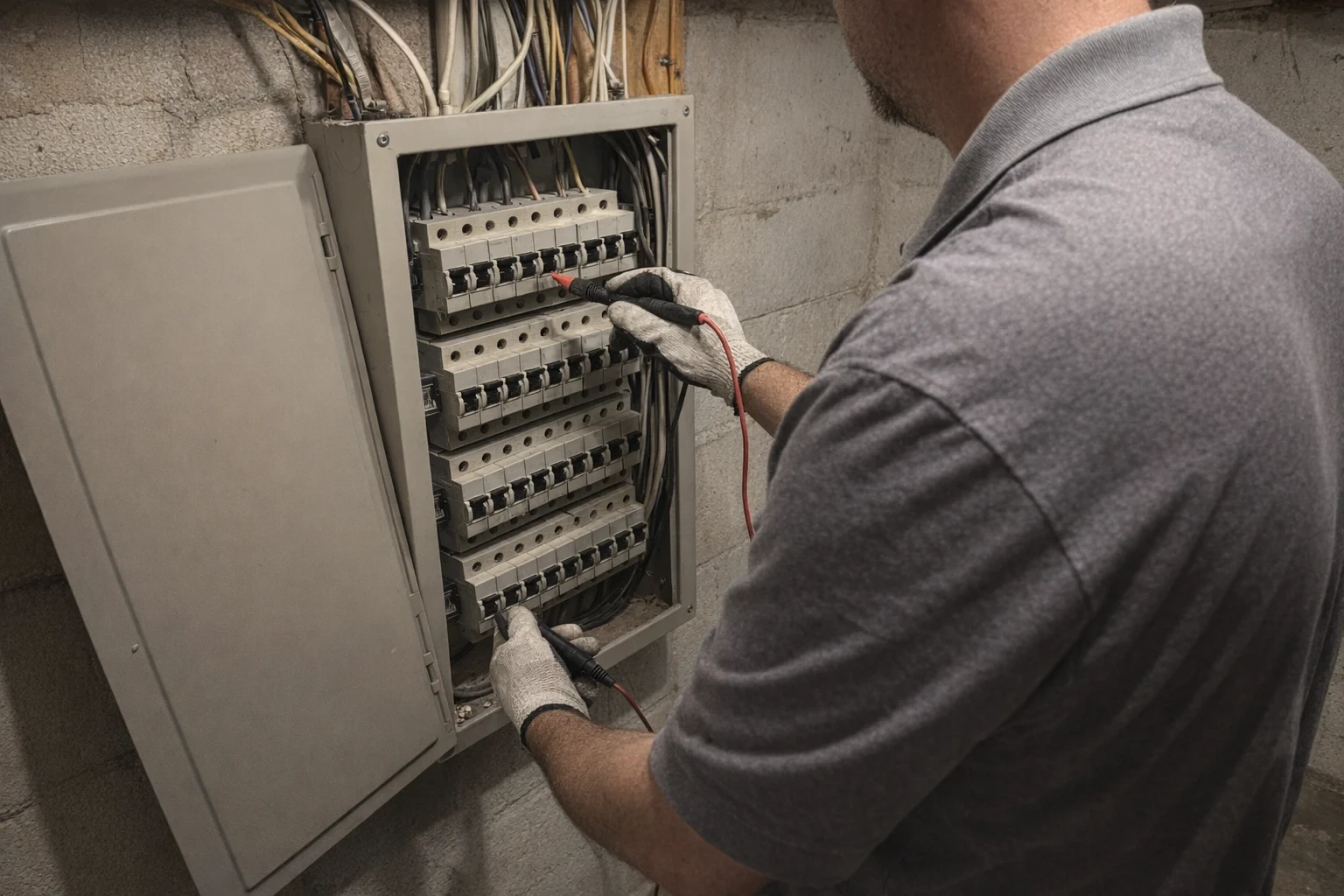
Marcus Chen in suburban Phoenix thought he understood circuit breakers. He'd replaced a few standard breakers himself over the years. So when his electrician quoted $375 to replace a single breaker during a panel upgrade consultation, he assumed he was being gouged. "I looked it up online," Chen told us. "Standard breakers are $30. Why would anyone pay $375 for one?"
He'd encountered his first AFCI (Arc-Fault Circuit Interrupter) breaker—and the price difference reflects a genuine technological leap, not just electrician markup. Understanding why these breakers exist, when they're legally required, and when you're simply paying for optional upgrades could save you hundreds on your next electrical project—or protect you from a costly code violation.
Price-Quotes Research Lab observes that the gap between standard and smart breaker pricing has widened 23% since 2023, driven by updated NEC requirements and manufacturing shifts. Here's what you need to know before your next breaker replacement.
Standard vs. Smart Breakers: The 2026 Pricing Reality
The electrical industry uses "smart breaker" as shorthand for breakers with integrated protection technologies—primarily AFCI and GFCI capabilities. These aren't luxuries or upsells. In specific locations and circumstances, they're code-mandated safety equipment that could prevent house fires.
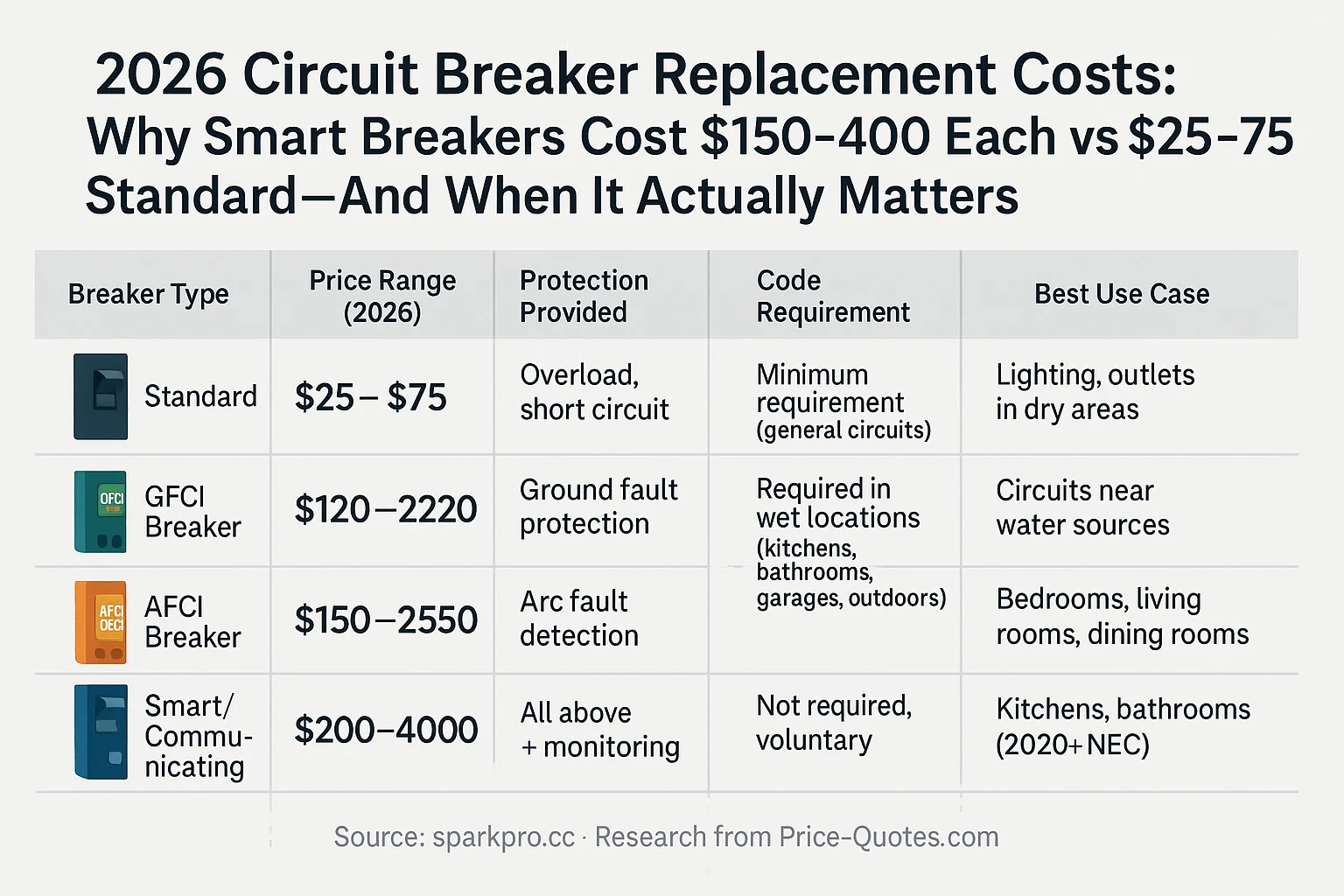
Standard Circuit Breakers ($25-$75 Each)
Standard single-pole circuit breakers provide overload and short-circuit protection. They trip when current exceeds safe levels—simple, proven technology that's been standard since the 1960s.
- 15-amp standard breakers: $25-$45
- 20-amp standard breakers: $30-$55
- 30-amp double-pole breakers: $55-$75
- 50-amp double-pole breakers: $70-$110
These prices reflect 2026 manufacturer retail. Electricians typically charge $10-$25 per breaker in bulk when purchasing for larger projects, but individual homeowner purchases at home improvement stores run these higher unit prices.
AFCI Breakers ($150-$250 Each)
Arc-fault circuit interrupters detect the unique electrical signature of arcing faults—sparking between damaged or loose wires that can ignite surrounding materials without tripping a standard breaker. According to the National Fire Protection Association, electrical fires account for approximately 46,000 home fires annually, with arcing faults responsible for a disproportionate share of ignition events.
- 15-amp AFCI breakers: $150-$200
- 20-amp AFCI breakers: $175-$250
- Combination AFCI/GFCI breakers: $200-$300
GFCI Breakers ($120-$220 Each)
Ground-fault circuit interrupters monitor for current leaking to ground—critical protection in wet locations. While GFCI protection has traditionally been handled through outlets, breaker-based GFCI protection covers an entire circuit and is required in newer construction.
Smart/Communicating Breakers ($200-$400 Each)
The newest category includes breakers with communication capabilities—Square D's Homeline PS, Leviton's Smart Lockpro, and Eaton's Smart Breakers. These integrate with home automation systems, provide energy monitoring, and can be remotely reset. They require compatible smart electrical panels and typically represent whole-home system investments rather than individual component replacements.
The Comparison Table: What You're Actually Paying For
When Code Actually Requires Expensive Breakers
Here's where homeowners most commonly get surprised: AFCI and GFCI breakers aren't optional upgrades in many situations—they're legal requirements. The National Electrical Code (NEC), updated in 2020 and adopted variably by jurisdictions, mandates AFCI protection in virtually all habitable rooms of new construction and major renovations.
Kitchens and Dining Areas
Under 2020 NEC Section 210.12, AFCI protection is required for kitchen and dining area circuits serving outlets that supply appliances. This includes countertop outlets—a common renovation trigger. If you're updating your kitchen's electrical, expect every general-use circuit to require AFCI breakers, not just standard units.
Living Rooms, Bedrooms, and Habitable Spaces
Bedrooms represent the most common AFCI requirement location. The NEC mandates AFCI protection for all 120-volt, single-phase, 15 and 20-amp branch circuits supplying outlets installed in dwelling unit living spaces—including bedrooms, living rooms, parlors, libraries, dens, hallways, closets, and similar rooms.
Real-world impact: A 2,000-square-foot home built before AFCI requirements might have 8-12 standard breakers. The same home built to 2020+ code could require 6-10 AFCI breakers just for living spaces, adding $900-$2,500 in material costs over a full panel replacement.
Laundry Areas, Garages, and Outdoors
GFCI protection (via breaker or outlet) is mandatory in laundry areas, garages, and outdoor circuits under NEC Section 210.8. For garage circuits serving power tools and equipment, GFCI breakers provide whole-circuit protection that's more robust than individual GFCI outlets.
When You Don't Need Them
Circuits serving dedicated appliances (refrigerators, dishwashers, washing machines—though washer requirements vary), water heaters, HVAC equipment, and sump pumps often fall outside AFCI requirements. Similarly, circuits in unfinished basements serving only hardwired equipment may use standard breakers. Your local authority having jurisdiction (AHJ) makes final determinations.
The Hidden Labor Equation
Breaker costs are only part of the equation. Professional installation labor varies significantly by task and location in 2026.
Individual Breaker Replacement ($100-$250 Labor)
When a single breaker fails or requires upgrading, electricians typically charge $100-$250 for the service call and installation. This includes:
- Diagnostic time to identify the problem ($50-$100)
- Breaker replacement labor ($50-$150)
- Basic testing and verification
Some electricians charge minimum trip fees of $75-$150 regardless of work performed, making individual small jobs less economical than batching repairs.
Panel Replacement or Full Upgrade ($1,500-$4,000+ Labor)
Complete electrical panel replacement involves significantly more labor:
- 200-amp panel replacement: $1,500-$3,000 labor (plus permit costs of $400-$2,500 depending on jurisdiction)
- Subpanel installation: $500-$1,500 labor
- Service upgrade (100 to 200 amp): $2,000-$4,000+ labor
For context, whole-home standby generators represent a separate major electrical investment that often triggers panel evaluation and potential upgrades.
AFCI/GFCI Breaker Upgrade Complications
Retrofitting AFCI protection into older panels presents specific challenges:
- Panel compatibility: Not all panels accept AFCI breakers. Federal Pioneer, Zinsco, and some older Square D panels have limited or no AFCI-compatible options.
- Neutral requirements: AFCI breakers require a dedicated neutral connection that older wiring sometimes lacks.
- Interference issues: Older homes with knob-and-tube remnants or shared neutrals can experience nuisance tripping with AFCI breakers.
These complications can add $200-$500 to retrofitting costs when rewiring or panel replacement becomes necessary.
Smart Breakers: When the Premium Actually Makes Sense
Beyond code compliance, some homeowners invest in smart breaker technology deliberately. Here's when the premium might be justified:
Energy Monitoring and Solar Installations
Homes with solar panel systems or those planning installations benefit from circuit-level energy monitoring. Smart breakers from manufacturers like Span, Schneider Electric's Square D E Series, or Leviton's smart load centers provide real-time per-circuit energy data that standard monitoring systems can't match.
Cost justification: If your utility offers time-of-use pricing, identifying high-consumption circuits enables behavioral changes that might save $50-$150 monthly on electric bills. Over a 10-year system lifespan, that's $6,000-$18,000 in potential savings against a $2,000-$4,000 smart panel premium.
Remote Reset Capabilities
For vacation homes, rental properties, or homeowners with mobility limitations, smart breakers that allow remote reset eliminate service calls for tripped breakers. A $150 service call avoided twice yearly over 10 years saves $3,000—potentially justifying a $500-$1,000 smart breaker investment for specific circuits.
Home Automation Integration
Advanced home automation systems integrate with smart breakers for automated load management—shedding non-essential circuits during peak demand, coordinating EV charging with other loads, or responding to grid emergency signals from utilities. For tech-forward homeowners committed to comprehensive automation, smart breakers represent a logical system component.
The DIY Trap: When Saving $100 Costs $10,000
Standard breaker replacement appears DIY-friendly. The process is straightforward: kill the main breaker, pop out the old breaker, insert the new one, restore power. However, this simplicity lures homeowners into situations beyond their expertise.
What Can Go Wrong
Mismatched breakers: Using a breaker that isn't specifically listed for your panel is a code violation and fire hazard. Challenger breakers, certain Federal Pioneer panels, and vintage Bryant load centers require specific compatible units.
Improper torquing: Since 2023, NEC Section 110.14 requires proper torquing of all electrical connections. Loose breaker connections create resistance, heat buildup, and fire risk. Professional electricians use calibrated torque screwdrivers; most DIYers don't own them.
Undiagnosed root causes: A repeatedly tripping breaker isn't necessarily a bad breaker—it might indicate a downstream short, overloaded circuit, or ground fault. Replacing the breaker without diagnosis just masks the problem.
Hidden AFCI requirements: A DIYer might correctly install a $40 standard breaker where code requires a $200 AFCI breaker, creating a code violation discovered during future home inspection or insurance claim.
When DIY Is Reasonable
Swapping a standard breaker for an identical standard breaker, when you've confirmed compatibility and the circuit has been definitively diagnosed as having a bad breaker (not a wiring issue), falls within reasonable homeowner skill. If you're uncertain about any aspect, hire a licensed electrician for at least the diagnosis.
2026 Market Factors Affecting Your Costs
Several 2026 market conditions are influencing breaker pricing and availability:
Copper and Raw Material Costs
Copper prices have stabilized around $4.20-$4.50 per pound in early 2026 after volatility in 2024-2025. While copper represents only a portion of breaker manufacturing costs, sustained high prices keep electrical component prices elevated compared to historical norms.
Supply Chain Normalization
Post-pandemic supply disruptions have largely resolved. Lead times for standard breakers are back to 1-3 days for most retail locations, with specialty AFCI and smart breakers at 1-2 weeks. This contrasts sharply with 2021-2022 when AFCI breakers sometimes required 8-12 week waits.
Tariff Impacts
The Section 301 tariffs on Chinese electrical equipment continue to affect pricing on budget-tier breakers and smart home devices. Higher-end equipment manufactured in North America and Mexico faces fewer tariff impacts, creating relatively better value at premium price points.
Panel Compatibility Constraints
Some older panels remain in homes across the country with limited or no AFCI-compatible breaker options available. For these situations, full panel replacement becomes the code-compliant path rather than individual breaker upgrades. This affects an estimated 3-5 million homes built with now-obsolete panel brands.
What to Do Next: Your Action Plan
Based on your situation, here's the practical path forward:
If You're Buying or Selling a Home
Request an electrical inspection that specifically evaluates panel age, brand, and code compliance. An inspector can identify AFCI requirements your jurisdiction enforces and any panel brands with known issues. Budget $200-$500 for a comprehensive electrical assessment.
If You Need a Single Breaker Replaced
Don't assume standard is sufficient. Describe your situation to an electrician: "I need a breaker replaced in a [year] [brand] panel in [room name]—what type is required?" Get the answer in writing. Comparing quotes from multiple licensed electricians typically saves 15-25% on individual jobs.
If You're Renovating
Before starting any renovation involving electrical work, get a panel evaluation. Many homeowners discover during kitchen or bathroom remodels that their panel can't accept AFCI breakers and requires complete replacement—a $3,000-$7,000 project better discovered before demo than during finish work.
If You're Building New
Budget 40-50% of your breaker costs for AFCI and combination breakers. In a typical 2,500-square-foot new home, expect 8-14 AFCI-protected circuits at $150-$250 each—$1,200-$3,500 in protection technology that wasn't required 15 years ago. This is baseline code compliance, not upgrade spending.
The Bottom Line
Marcus Chen's $375 AFCI breaker wasn't a rip-off—it was a legal requirement for his garage workshop circuit in a home being brought up to current code. The confusion comes from a generation of homeowners who replaced standard breakers when that's all they needed, and now face a code landscape that increasingly requires smarter protection.
The price gap between standard ($25-$75) and AFCI ($150-$250) breakers reflects genuine technological differences and manufacturing costs. Whether you're paying for one depends entirely on your panel, your wiring, your jurisdiction's code adoption, and your specific circuit. The key is knowing before you buy—and understanding why your electrician might hand you a $250 bill for a component you once bought at the hardware store for $35.
Price-Quotes Research Lab observes that homeowners who request itemized quotes and ask specifically "is this breaker code-required or an upgrade?" consistently receive clearer pricing and fewer unexpected line items. The confusion around breaker pricing benefits no one—except perhaps the contractors who rely on it.